




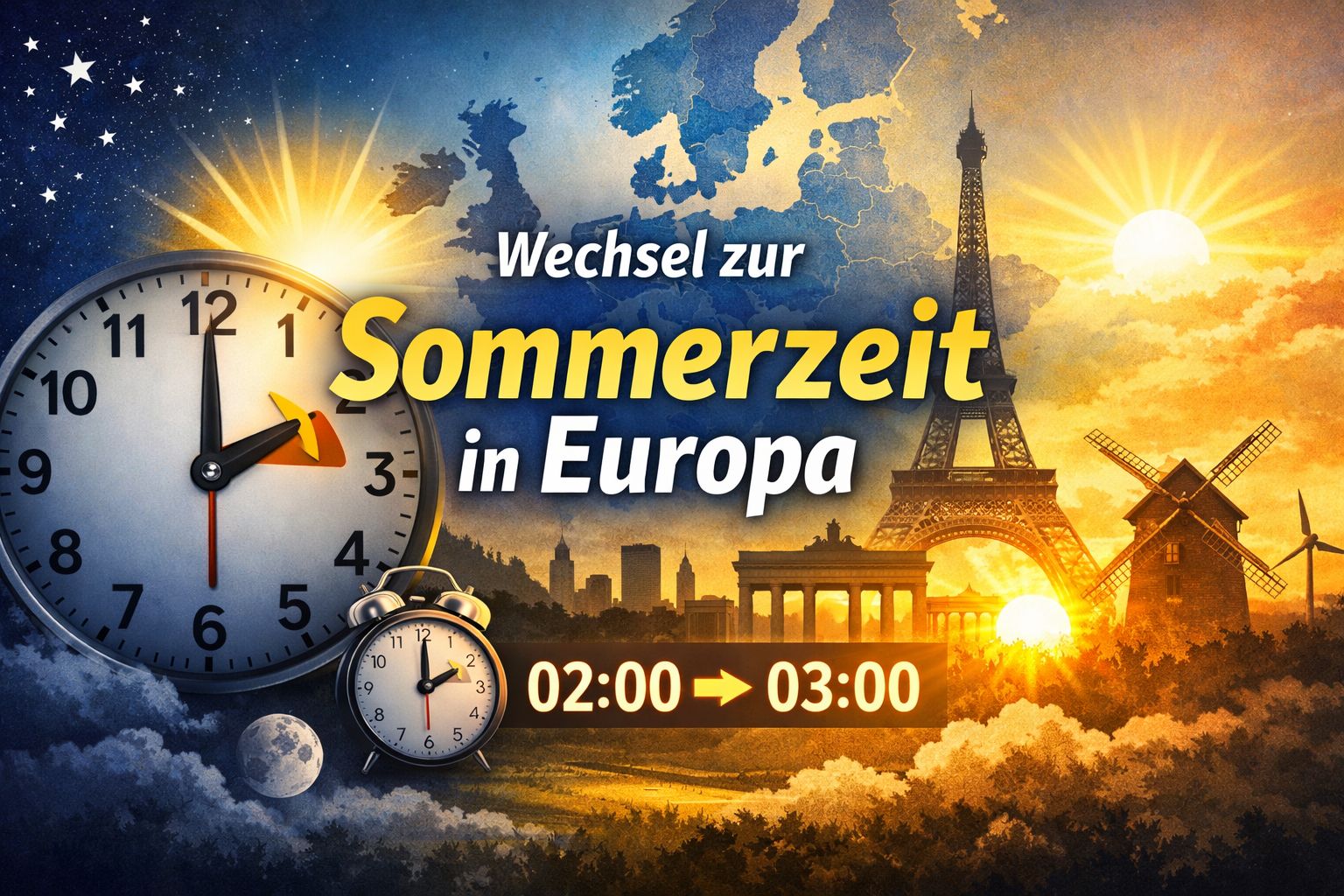
Switch to daylight saving time in Europe
On March 29, 2026, most European countries will switch to daylight saving time (DST) in accordance with the unified time standard “Coordinated Universal Time” (UTC, not to be confused with a time zone), which serves as a reference for all time zones worldwide.
In other words, this is a seasonal shift of official time by one hour forward in spring and one hour backward in autumn, practiced in many countries for decades. Among European countries, only Iceland, the Republic of Belarus, and the Russian Federation do not follow this practice.
Countries in the Central European Time zone (CET) will switch to daylight saving time (CEST) on March 29, moving clocks from 02:00 to 03:00. These include Malta, Monaco, Montenegro, the Netherlands, North Macedonia, Norway, Gibraltar, Hungary, Italy, Kosovo, Liechtenstein, Luxembourg, Slovakia, Slovenia, Spain, Sweden, Croatia, Switzerland, Poland, Austria, San Marino, Serbia, Albania, Andorra, Belgium, Bosnia and Herzegovina, the Czech Republic, Denmark, France, Germany, and the Vatican.
Countries in the Eastern European Time zone (EET) will switch to daylight saving time (EEST) on March 29, moving clocks from 03:00 to 04:00. These include Finland and the Åland Islands, Moldova, Bulgaria, Greece, Estonia, Cyprus, Latvia, Lithuania, Romania, and Ukraine.
It should be noted that this “phenomenon” of switching between summer and winter time has a complex history closely linked to the abolition and reintroduction of this practice at different times. Germany and Austria-Hungary were among the first to introduce daylight saving time in 1916 during World War I, aiming to save coal and conserve energy.
Many countries later abandoned this practice. Germany, for example, abolished it in 1918 and reintroduced it in 1940. After World War II, it was abolished again in 1945, then reintroduced in 1949 in West Germany and in 1950 in East Germany. In the Federal Republic of Germany, it was abolished in 1960 and reinstated during the oil crisis of 1973.
This process is intended to make more efficient use of daylight during the warmer months, saving energy and improving quality of life through longer daylight hours in the evening. Some studies suggest that daylight saving time reduces traffic accidents, lowers crime rates, and increases productivity.
However, these claims are increasingly questioned today and are the subject of ongoing debate.
Modern electronic devices and changing patterns of energy consumption have minimized the potential savings. Moreover, time changes can disrupt human circadian rhythms, lead to worsening of chronic conditions in certain groups, and in some cases increase the risk of depression, other psychological disorders, and temporary loss of concentration. Under certain circumstances, it may also contribute to social dissatisfaction.
In recent years, the European Union has been actively discussing abolishing daylight saving time. The proposal suggests that each country should independently decide whether to remain permanently on summer or winter time. The results of votes and public debates show that opinions are divided, and a final decision requires consideration of many factors, including geographical location, climate conditions, and socio-economic consequences.
Thus, while most Europeans continue to prepare for the annual clock change, the question of abolishing this practice remains open.
Tags: daylight saving time Europe 2026 , clock change Europe March 2026 , summer time Germany 2026 , clock change Germany date , when do clocks change Europe , DST Berlin 2026 , CET CEST difference , EET EEST difference , countries changing clocks Europe , daylight saving countries Europe , date of clock change Europe 2026 , summer and winter time Europe , DST Europe explanation , clocks forward Europe , why clocks change Europe , history daylight saving Europe , clock change France Italy Spain , clock change Poland Austria Switzerland , clock change Ukraine 2026 , summer time Finland Greece Romania , time change health effects , circadian rhythm clock change , energy saving daylight saving , EU daylight saving debate , abolishing DST Europe , news Germany daylight saving , Berlin news clock change , Europe news daylight saving , time zones Europe change , Europe clock adjustment
Categories: Latest
